
Compare Vigo County Property Value Types
Indiana's key gross total sits on one line. It is labeled Assessed Value Total Land and Improvements, and it should be kept with its land and improvement parts and its assessment date.
| Value | What It Is | Where |
|---|---|---|
| Assessed value | Mass-appraisal value for taxation | Beacon, Form 11, DLGF |
| Market-value-in-use | Indiana's valuation concept | Assessment guidance |
| Last sale price | Transaction amount, possibly non-market | Sales disclosure and deed |
| Land and improvements | Components of the gross total | Parcel report |
Indiana assesses at a 100 percent level. Its ratio-study formula still does not turn a mass appraisal into a private one. Age, grade, condition, use, and annual trending all shape the assessor's numbers, and the DLGF assessed-value search guidance shows the state route and the total worth preserving.
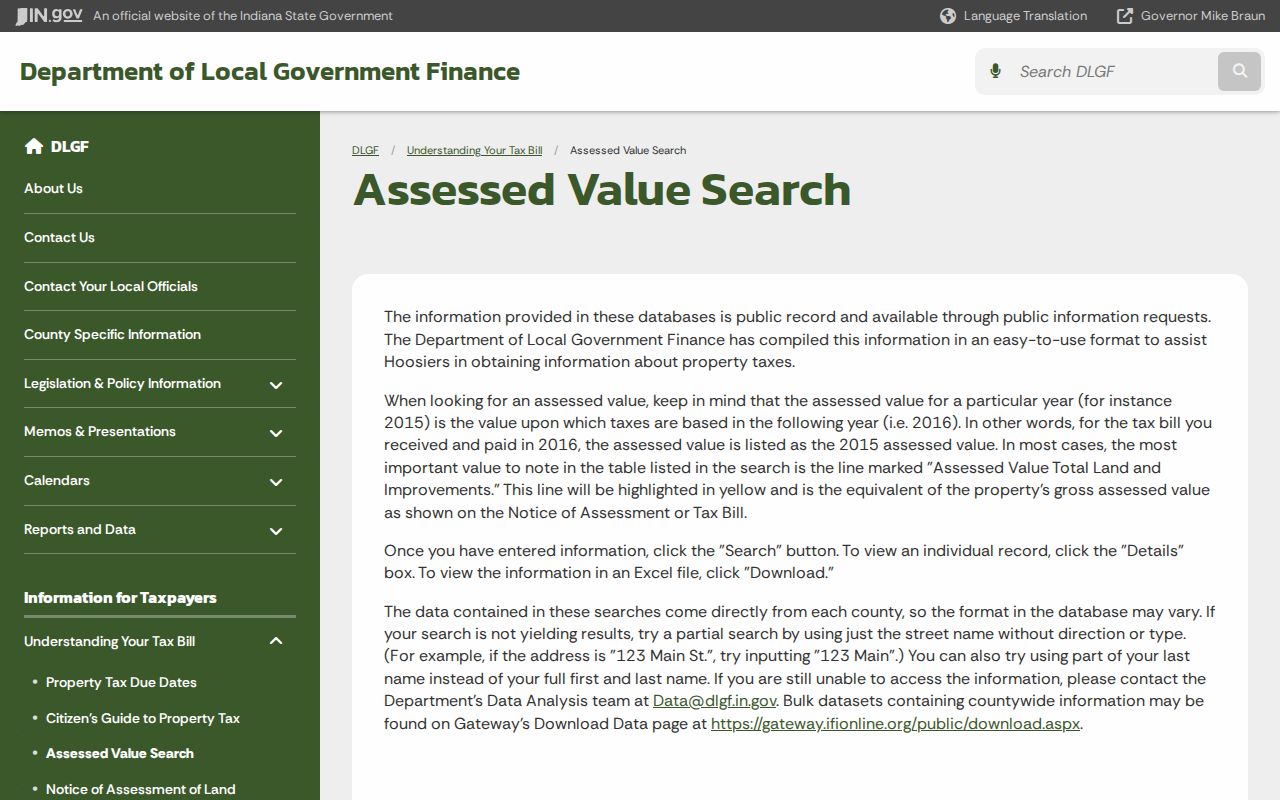
State guidance keeps that total in the assessment record.
Read Vigo County Land and Improvement Values
The official parcel sample separates land from improvements and lists dated value-history rows. Keep the split intact. Construction, demolition, corrections, trending, reassessment, a use change, or a parcel reconfiguration can each alter one part. The exempt sample shows shifting land values with no improvement value, so it should not be generalized to a nearby home.
Read the Reason Behind a Vigo County Value Change
Every value-history row needs its date and reason code. The county sample applies annual-adjustment wording across several years. That shows movement in the record. It does not by itself identify a renovation, sale, or appraisal. Weigh the building description, property class, transfer date, and any permit record before naming a cause. Demolition, new construction, a use change, a correction, or a split can move the parts differently.
Hold the parcel key constant across years. If the key changed, test whether the tract was divided or combined first. Old and new records may cover different land even when the address looks familiar. A familiar street is not proof. That is also why a neighborhood average should never replace parcel-level facts from the property records.
Apply Indiana's 2026 Reassessment Context
Statewide cyclical reassessment begins July 1, 2026 for the 2026 pay-2027 cycle. DLGF says roughly 25 percent of parcels are examined each year over four years. Vigo's exact local schedule was not published, so confirm the assessment date.
Understand Vigo County Market-Value-in-Use
Indiana's valuation concept is market-value-in-use. DLGF guidance describes a mass appraisal built on age, grade, condition, use, and annual sales trending. The goal is a common framework across many parcels. It is not one buyer and one seller negotiating a deal. Nor is it an appraiser inspecting a single property for one effective date.
The 100 percent level gets misread often. It sets the statutory assessment level across property classes. It does not promise that an assessed value equals a listing price, contract price, replacement cost, or private opinion. Ratio studies compare assessed values against qualifying sales to judge level and uniformity across groups.
Estimate Vigo County Value from Official Records
Use Beacon for the parcel and DLGF's assessed-value route for state guidance.
- Search the situs and confirm the full parcel key.
- Open the report and save land, improvements, total, date, and reason.
- Find any disclosed sale amount.
- Read transaction flags before comparing it.
- Assessed value
- The value established through the assessment system.
- Market-value-in-use
- Indiana's mass-appraisal valuation concept.
- Assessment ratio
- Assessed value divided by sale price for ratio analysis.
Judge Vigo County Sale Prices Before Comparing
The search covers transfers after July 1, 2008. Read the flags first. Sheriff sale, tax sale, short sale, quitclaim, auction, related-party, and partial-interest conditions can make a disclosed amount non-market. Nominal deed consideration can also diverge from the economics of the transfer. Some disclosed amounts reflect distress, not market value.
Note: A deed or disclosure amount is a dated transaction clue, not an automatic estimate of the parcel's current value.
Use the Vigo County Sales Disclosure Carefully
A Sales Disclosure Form is generally filed with a conveyance. The assessor reviews it. Its fields can include the parcel or tax ID, the land and improvement split, the conveyance date, the transaction type, and flags for multiple forms. Transfers after July 1, 2008 fall within the state search framework DLGF describes, subject to statutory limits on phone information.
One form generally covers one parcel. Contiguous parcels in the same taxing district can share a form when consolidation conditions are met. That detail matters when a recorded price looks too large or small for the parcel. Check the deed records. The deal may have covered several tracts, a partial interest, or property beyond the subject lot.
Separate Vigo County Gross and Taxable Values
Deductions, exemptions, credits, and tax caps can all shift a taxable amount. None of them touches the gross assessed value. Keep the two figures distinct. The same holds for a tax bill, which reflects caps and credits rather than title. The Vigo County property tax page covers bills and appeals. The valuation side stops at what each number means and where it appears.
Build a Vigo County Value Comparison Sheet
Give every source its own row. List the parcel number, property class, situs, source name, value type, effective date, land amount, improvement amount, gross total, taxable amount, and any transaction flags. Note the query date too. That structure keeps a 2026 pay-year tax screen from being compared carelessly with a 2025 assessment or an older deed. If the parcel number changed, check whether a split or combination altered the land being measured.
Nearby sales need more than geography. Compare use, class, lot size, improvements, condition clues, and the circumstances of each sale. Closeness alone never makes another parcel comparable. A public or exempt parcel, commercial property, historic site, unusual subdivision lot, partial-interest sale, or sheriff sale can behave very differently from the subject, even on the same street. Weight the match before trusting the number.
The county sample shows why components matter. Its history lists assessment dates, adjustment reasons, shifting land totals, and zero improvements for an exempt classification. Those facts explain one parcel's record, not a residence. Always identify why a comparison is similar before using its number in any property records analysis.
Explain Vigo County Value Changes with Records
Begin with the assessment reason and its date. Then check the materials published by the Vigo County Assessor. Look for a sale, construction, remodeling, demolition, or use change. Also check for a correction, annual trend, reassessment, or a parcel split or combination. A building permit can show that work was approved or inspected. It does not establish the resulting value or prove lasting compliance.
A big change is not automatically an error. Set the current parcel report beside the prior year and the Form 11. Add any available sales disclosure and the property characteristics. Is an objective field wrong? Preserve the source showing the mismatch. When the disagreement is about valuation judgment, other evidence may serve. Comparable sales, a recent subject sale, an appraisal, or income information may be relevant.
Appeals are a separate matter, but timing still shapes how a record reads. The Form 11 notice controls the practical deadline. The DLGF mail-date table for Vigo is blank. No date can be lifted from it. Check the live notice and the Assessor rather than reusing a date from another year.
Understand Vigo County Property Value Limits
An assessor value supports taxation. It is no survey, title result, listing estimate, or private appraisal, so record its effective date and source. Asking prices differ.
Value is not price. Vigo County assessed value is not what a property must sell for, and it does not replace a parcel-specific appraisal.