
Read Vigo Property Tax Records
Three Vigo County offices share the tax record. The Assessor sets gross value and keeps the parcel facts. The Auditor administers deductions. The Treasurer collects each bill and reports whether it is paid. Portals make lookup fast. Still, only the responsible office can resolve a disputed field in the record.
| Field | What It Shows | Where |
|---|---|---|
| Land and improvements | Parts of gross value | Assessor and Beacon |
| Taxable and pay year | Assessment and collection years | Gateway |
| Deductions | Items affecting taxable value | Auditor |
| Installments | Paid or remaining sums | Treasurer |
| Tax district | Authorities tied to parcel | Bill |
Indiana assesses at 100 percent of market-value-in-use, so the figure is neither a sale price nor a private appraisal. Deductions can change the bill without touching title.
Match Vigo Tax Search Fields
Two documented bill routes serve the county: the Gateway Tax Bill Lookup and Vigo Low Tax Info. Pull the exact parcel or duplicate number from Beacon first.
| Key | Result | Verify |
|---|---|---|
| Parcel | Exact tract | Suffix |
| Duplicate | Tax account | Pay year |
| Taxpayer | Name-linked bills | Parcel |
A clear bill is not a lien search.
Vigo Assessments Change Annually
Indiana trends assessments annually. A cyclical reassessment starting July 1, 2026 covers about one quarter of parcels per year over four years, and Vigo publishes no parcel schedule for its share. The DLGF Vigo page posts the county reports.
Look Up a Vigo Tax Bill
Start with the parcel report. End with the Treasurer's payment status, keeping the taxable year and pay year labeled separately and confirming the parcel and duplicate numbers before reading any installment.
- Copy parcel and duplicate identifiers from Beacon.
- Search Gateway or Low Tax Info for the proper year.
- Read installments and compare deductions with Auditor records.
- Ask the Treasurer about balances and the Auditor about roll data.
- Gross assessed value
- Value before eligible deductions.
- Tax levy
- Amount raised by a taxing unit.
- Homestead deduction
- Indiana owner-occupancy relief.
- Tax lien
- A claim tied to unpaid property tax.
Separate Vigo Tax Year Labels
Taxable year and pay year mark different stages. Keep both when comparing Beacon, Gateway, and Treasurer results. The duplicate number ties a parcel to its account, and the taxpayer of record can differ from the deeded owner. That gap is common. A mailing party, an estate, a recent buyer, or a slow update may explain it, so compare the latest deed, the parcel report date, and the bill year before asking an office to resolve the record.
Track Vigo Tax-Sale Dates
The Vigo document center posts current tax-sale notices when they appear. A list alone is not full legal status. For each parcel, track the delinquency year, notice date, sale date, and any redemption, order, tax deed, or recording date. Confirm the current handout with the Auditor or Treasurer. Then search MyCase and inspect the Recorder index. Use the live notice for deposit and redemption terms.
Vigo Tax Bills Use Gateway
Open the Gateway Tax Bill Lookup source first.
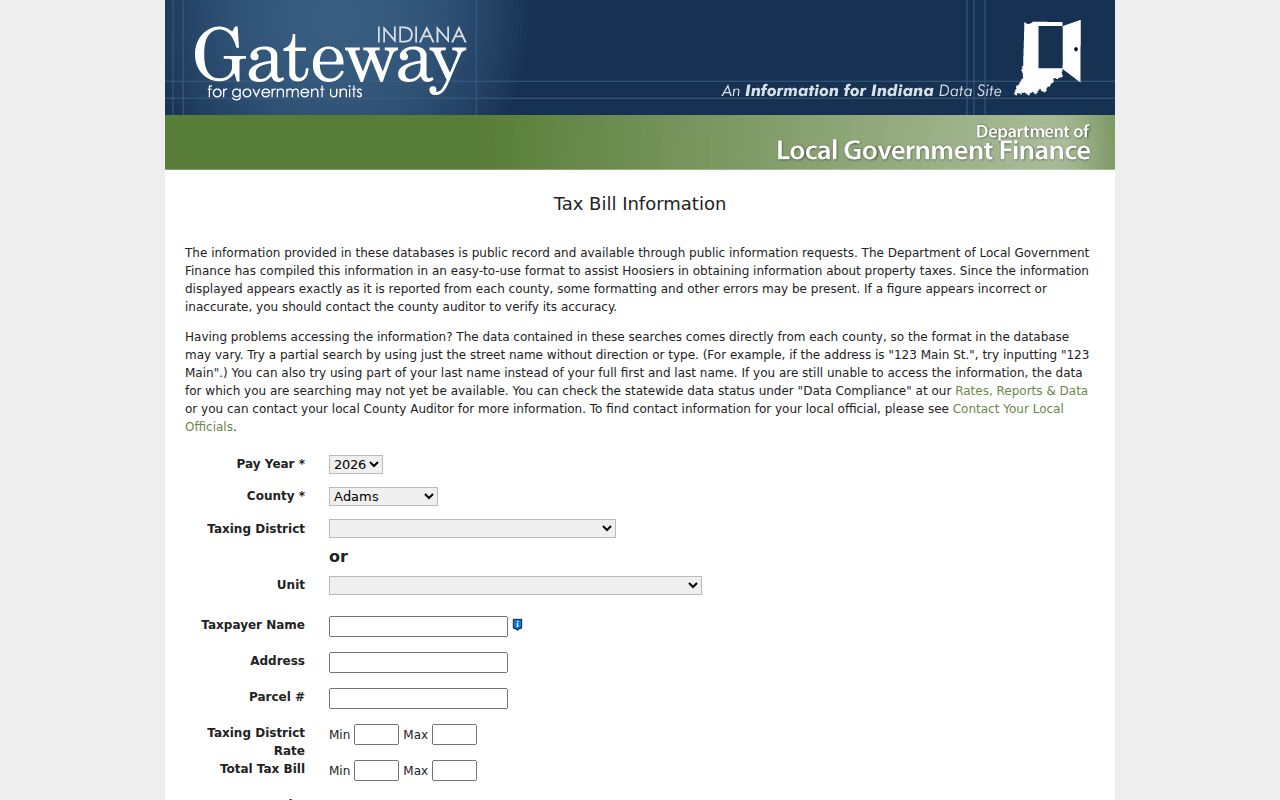
The official lookup screen is only a starting point. Verify its parcel, duplicate number, and pay year with the Vigo Treasurer before relying on it.
Build a Vigo Appeal Packet
An appeal is really a data-packet task. Gather Form 11, the parcel card, land and improvement values, the assessment date and reason, the subject sale, comparable sales, photos, and any appraisal or income evidence. A Sales Disclosure Form can support the analysis for transfers after July 1, 2008. Not every sale makes a sound comparable. Sheriff sales, tax sales, related-party transfers, quitclaims, auctions, and partial interests all need care. Treat a ratio as an analytic clue, never an appraisal.
Reach Vigo Tax Offices Directly
The Assessor, at 189 Oak Street, handles valuation. The Treasurer, at 191 Oak Street, handles bills and balances. The Auditor takes tax-roll and deduction questions. Have the parcel number, duplicate number, year, and disputed field ready. Include the desired copy when you call.
Indiana APRA backs inspection and copying of public records, with exceptions and reasonable production time. A focused parcel request works best. Ask about format and cost before ordering a large set.
Note: A paid current bill does not certify everything. Other liens or recorded claims may still affect the property.
Appeal a Vigo County Assessment
Indiana's route starts with the Assessor and Form 130. From there a case can move to PTABOA, and later review uses Form 131 before the Indiana Board of Tax Review. The DLGF appeal page carries the current forms.
Appeal window. Use the deadline on the current Form 11 and state instructions. Save proof of filing and every exhibit.
Check Vigo Tax District Codes
A tax district links a parcel to its taxing authorities. It beats a ZIP as a clue but does not prove city limits. Save the district from the parcel report and the bill. If they differ, compare years. Ask whether annexation, a split, or timing explains the mismatch.
Vigo Sale Price Needs Context
Recorded consideration, Sales Disclosure Form data, assessed value, and the tax bill are four different numbers. A deed may show nominal consideration. The SDF can carry transaction flags. Neither number makes the tax bill an appraisal. Check whether the transfer was open-market, related-party, sheriff, tax, auction, quitclaim, partial-interest, or otherwise flagged, and preserve the source and date.
Vigo Appeals Start With Form 130
A dispute over a Vigo County assessment starts with the local Assessor and Indiana Form 130. The claim should be specific. It needs the parcel, the assessment date, the disputed facts, the requested value, and the evidence. Objective issues include a wrong measurement or classification. Subjective disputes turn on judgment about value, grade, condition, or comparable property. If local review stalls, the Property Tax Assessment Board of Appeals hears the county case.
Form 131 covers a later Indiana Board of Tax Review appeal. The DLGF appeals page posts current forms and instructions. Follow the deadline on the current Form 11. A remembered annual date may be wrong.
Meet the stated deadline. Save proof of filing and copies of every exhibit. A payment dispute belongs with the Treasurer or Auditor unless it also raises a valuation issue.
Compare Vigo Tax Access Channels
Online systems work best as finding aids. Beacon carries assessment and parcel facts. Gateway and Low Tax Info handle tax-bill routes. The Assessor, Auditor, and Treasurer offer counter, phone, and request support for records in their custody, and no single result replaces the others.
| Need | First route | Fallback |
|---|---|---|
| Gross assessment | Beacon parcel report | Assessor, 189 Oak Street |
| Deduction or tax roll | Bill and parcel record | Vigo County Auditor |
| Balance or installment | Gateway or Low Tax Info | Treasurer, 191 Oak Street |
| Sale notice | County document center | Auditor and Treasurer |
Need a balance confirmed right now? Call the Treasurer at (812) 462-3251 with the parcel number handy. Have the duplicate number, taxable year, and pay year ready too. Assessment questions go to the Assessor at (812) 462-3358.
Vigo Tax Numbers Serve Different Jobs
Each Vigo County tax figure answers a different question. Gross assessed value adds land plus improvements before any deductions come off. Taxable value is what remains after deductions apply. The bill then layers on local rates, credits, and caps under the Indiana system. A last sale price records a transaction. Market-value-in-use is the state's own assessment concept. So these numbers can disagree without anything being wrong.
Different records own different answers. The Form 11 and parcel card anchor assessment questions. The tax bill controls the amount charged and paid. A deed or Sales Disclosure Form supplies the transfer story. Always compare like years and like fields. When a figure looks off, ask the office that produced it to walk through the source, date, and calculation.
Note: Assessment research measures the tax record, not legal ownership or current sale value.