
Identify Who Owns a Vigo County Property
Ownership research starts with a parcel. Never begin with a broad name search. Enter the situs address in the county-linked Vigo Beacon portal and copy the full state parcel key, the Auditor tax ID when present, the legal-description shorthand, and the exact owner label. Carry that name to the Recorder index next. That way, the assessor's entry stays distinct from the recorded deed that actually documents the transfer.
- Normalize the address, including directionals and street suffixes, and find its Beacon parcel.
- Read the Deeded Owner row under Owner - Auditor's Office.
- Search that legal name in Doxpop Recorder and identify the latest deed.
- Compare the deed's grantee, recording date, and legal description with the parcel result.
Save your query date whenever a sale looks recent. Vigo County publishes no set interval between recording and the assessor's roll update, so a newer deed can precede the owner the tax roll shows.
Read Vigo County's Deeded Owner Label
The sample parcel report never claims a title finding. Instead, it places Deeded Owner inside an Owner - Auditor's Office section. The mailing address sits apart. That wording matters. The person receiving tax mail may not occupy the property, and the situs address only identifies the land being assessed in Vigo County.
- Owner of record
- The name carried in the assessment or auditor roll.
- Grantee
- The party receiving an interest in a recorded deed.
- Situs address
- The physical location of the parcel, distinct from owner mail.
- Title
- The legal ownership interest, which a portal display alone cannot determine.
Note: Record the field label and the search date so any later discrepancy can be explained rather than treated as an error.
The Vigo County Assessor page opens the parcel system. That office maintains the parcel data. Contact the assessor when the displayed deeded owner seems to lag a recent transfer.
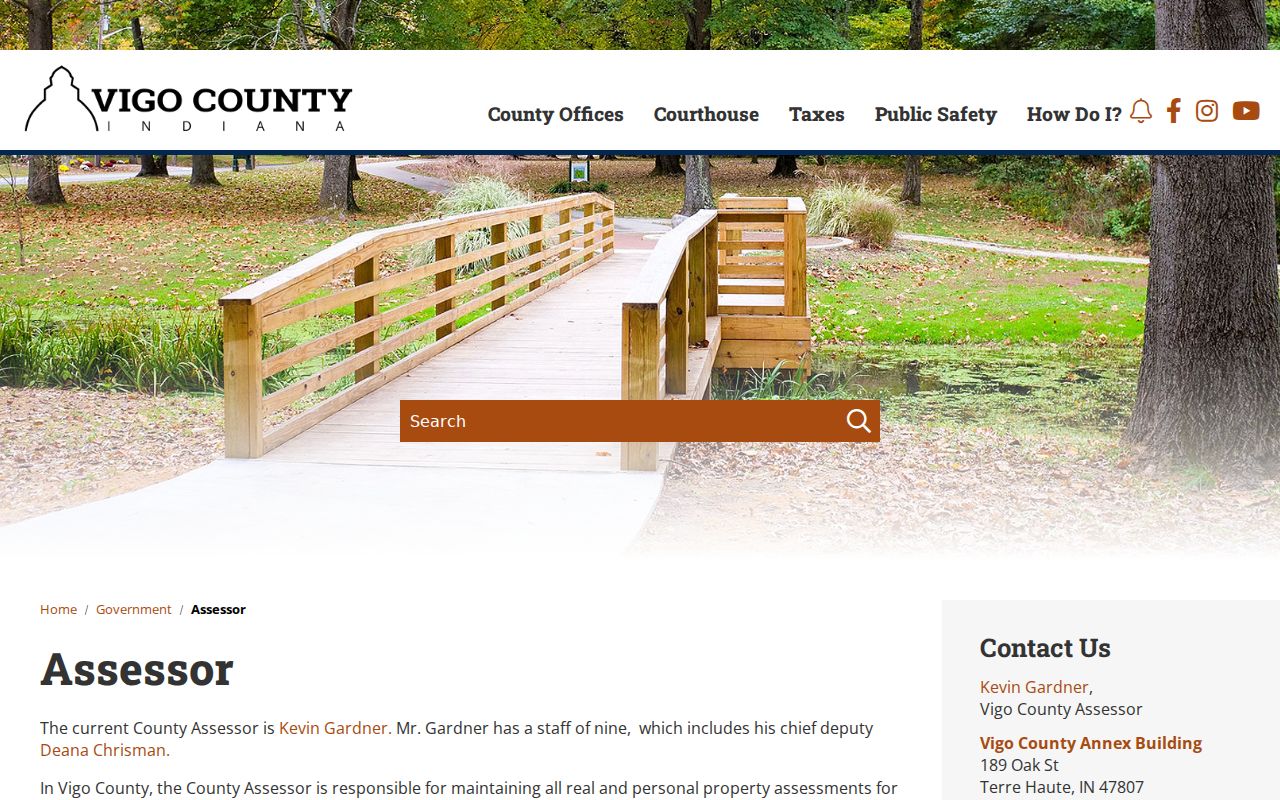
The page names the office that keeps Vigo County deed records, so a call can settle any lag in the deeded-owner field.
Trace the Vigo County Owner to a Recorded Deed
The Vigo County Recorder keeps deeds and every other instrument affecting real property. Doxpop's Vigo index reaches back to November 1996. Scanned images begin in January 2001. Search the displayed owner as grantee, then compare the most recent plausible conveyance against the parcel's legal description. A matching name alone proves nothing.
Doxpop cautions that its data is not the official record. Images can require login or subscription. If an image will not load, contact the Recorder at 199 Oak Street in Terre Haute, or request a plain or certified copy under current office procedures. Older ownership sits in deed books and microfilm.
Where Vigo County Property Ownership Appears
No single Vigo County screen proves ownership. Each source answers a narrower question, so the strongest result comes from matching parcel identifiers and recording dates across the county's systems.
| Where ownership is shown | What it gives | How current |
|---|---|---|
| Beacon parcel report | Deeded Owner, mail address, parcel key, situs | Roll date should be checked with Assessor |
| Recorder / Doxpop | Latest deed, grantee, document date and description | Newest recorded instrument is the transfer evidence |
| INBiz | Legal business name, status, filing and registered-agent data | Based on current entity filings |
| Tax bill | Taxpayer, duplicate, parcel and pay year | Tax-cycle record, not title proof |
The taxpayer on a tax bill can differ from the deeded owner. Tax and recording cycles serve different purposes. Use Gateway Tax Bill Lookup to reconcile the parcel and duplicate, never to substitute a taxpayer name for the Vigo County deed.
Identify Vigo County LLC, Trust, and Estate Owners
Owners are not always individuals. A parcel can belong to an LLC, a trustee, an estate, a public body, or someone acting in a stated capacity. Preserve the entire name exactly as recorded. For a company, search the official Indiana INBiz Business Search by legal name or business ID. Entity filings and registered-agent details help identify the organization. They do not convert company-owned land into personal ownership.
Trustee and estate wording deserves the same restraint. A probate transfer may link a MyCase docket, an estate order, a personal representative's deed, and the Recorder entry. Follow those records instead of guessing who benefits. Government ownership is stated as the named public body, never attributed to the officeholder who happens to serve.
Resolve a Missing Vigo County Owner Match
A blank result means no match, not no owner. Try surname-first and normal name order first. Also try initials, spouse names, entity suffixes, subdivision names, the full parcel key, and the Auditor tax ID. Deeds recorded before November 1996 also fall outside Doxpop's stated online index boundary.
Vigo County has one unusually specific failure mode. Doxpop reported missing legal-description data from October 7 through October 25, 2019. The gap was repaired. Other index fields kept working. For that window, rerun searches by grantor, grantee, document number, and recording date, and save both failed and successful queries in the owner worksheet.
Use Vigo County Property Watch as an Alert
Doxpop Property Watch offers a free name-based alert. Choose Indiana and Vigo County, enter one full name, and supply an email address. The service can flag later documents filed under that name. That is useful after confirming an owner, or when watching for an unexpected filing against a Vigo County parcel.
Property Watch is not continuous title monitoring. It cannot guarantee that fraud will be stopped. Verify any alert with the Recorder before acting. If a suspicious document suggests identity theft, preserve the alert, the document details, and the office response, then use official law-enforcement and consumer-protection routes rather than confronting anyone named in an index.
Build a Vigo County Owner-Finding Worksheet
A worksheet keeps every answer tied to its parcel. Start with the normalized situs address. Then capture the Auditor tax ID. Add legal-description shorthand, deeded owner, owner-mail address, assessment query date, and any visible transfer-history entry. A second group holds the newest deed's document number and recording date. It also covers grantor, grantee, deed type, capacity, and controlling legal description.
Tax-bill fields belong in a comparison group only. A tax record answers billing questions. It may name a taxpayer who differs from the deeded owner. So list the taxpayer, duplicate number, taxing district, taxable year, and pay year there. GIS adds spatial context but never decides title. Mark each conflict, then direct it to the custodian responsible for that field.
Address mismatches call for methodical testing. Try directionals, street suffixes, the parcel number, the Auditor tax ID, subdivision, and owner variants. A split or combination can leave an old address tied to a retired key. When a name search misses in Recorder results, work the angles: surname-first order, initials, spouse names, entity suffixes, trustee or estate capacity, and earlier source-of-title parties.
This log shines after a recent closing. It shows whether the deed is newer than the assessment display. That gives the Assessor a precise question. Vigo publishes no standard roll-refresh period. So the safe statement is that the systems may differ in timing. The newest matching recorded instrument is the better transfer evidence. The office should confirm when the roll will reflect it.
Limits on a Vigo County Ownership Lookup
An assessor result answers who owns this property according to the roll. It cannot establish occupancy, clear title, lien priority, precise boundaries, or an unrecorded interest. A deed index is only a finding aid. The Recorder has no affirmative duty to search liens or certify that none exist. Legal rights demand more. Certified instruments and qualified title or legal work are appropriate when rights turn on the answer.
Use the result with care. A Vigo County owner lookup supports lawful property research. Never use owner or mailing information to stalk, harass, intimidate, or harm anyone.
Indiana confidentiality rules can protect certain information. Public records may redact sensitive fields, and Address Confidentiality Program participation shields protected addresses in designated records. A redaction never signals wrongdoing.